- Home
- IT Help Desk
- Nearshore Help Desk Services Outsourcing: Why 74% of Companies Are Moving Away From Offshore in 2026
Nearshore Help Desk Services Outsourcing: Why 74% of Companies Are Moving Away From Offshore in 2026


Mustafa Ahmed
Tech copywriter with four years of experience writing for FinTech brands and...
More about the authorMay 17, 2026
10 mins
Table of Contents

According to Gartner’s 2025 workforce data, 74% of companies are planning to shift more of their offshore workforce to nearshore or onshore models to reduce risk and improve communication. That’s not a trend. When three out of four companies move in the same direction, you’re watching a correction.
For years, offshore managed IT help desk services outsourcing was the default because cost was the only metric anyone tracked. That math doesn’t hold up anymore. The top driver now? Access to specialized talent.
So the question for IT leaders evaluating nearshore help desk services outsourcing isn’t whether it makes sense. It’s what the data actually shows, where offshore falls apart for help desk work specifically, and what the real numbers look like when companies make the switch.
Where offshore falls apart for help desks
Time zones kill resolution speed
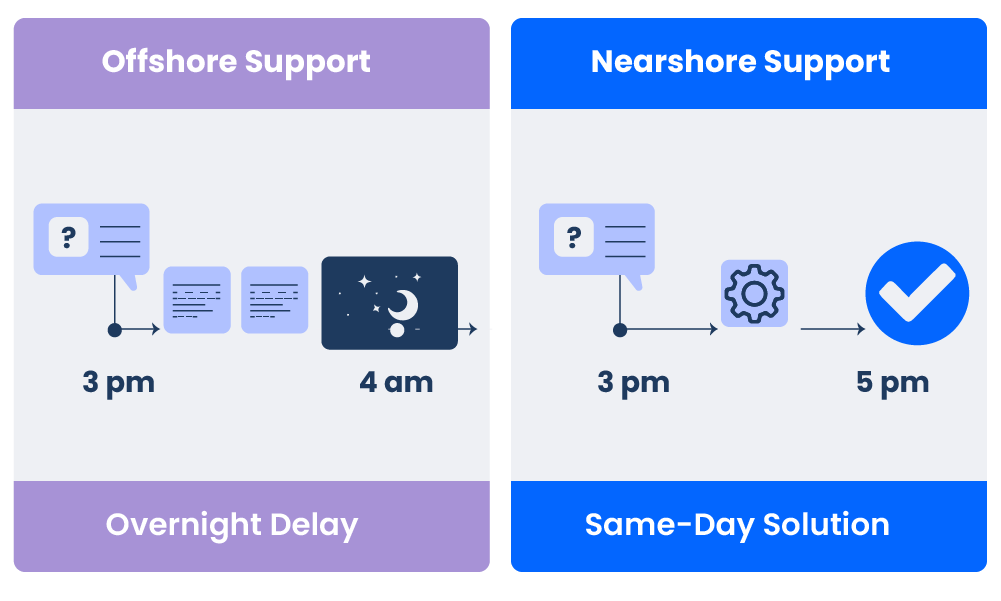
Help desk is real-time work. Unlike software development, which can survive asynchronous handoffs, tickets require immediate triage, live back-and-forth with end users, and fast escalation. With an 8-12 hour offset, a P1 ticket logged at 3pm EST doesn’t get specialist attention until the next morning. That’s a full business day lost.
The HappySignals Global IT Experience Benchmark Report (2025) put a number on this: each time a help desk ticket gets reassigned, end-user satisfaction drops by 8 points and the user loses an average of 2 additional hours of work time. In offshore models, tickets don’t just get reassigned between people. They get reassigned between time zones. That satisfaction hit compounds faster than most IT leaders realize.
And here’s the part that makes it worse. That same HappySignals report found nearly two out of three IT professionals admit that managing day-to-day operations is so overwhelming that user experience takes a back seat. When you layer cross-timezone coordination on top of an already stretched team, the help desk stops being a support function and starts being a source of friction.
It’s not about accents
This isn’t about English proficiency. It’s about escalation behavior, problem framing, and the way agents handle ambiguity.
Some offshore cultures prioritize indirect communication and avoid pushback. That becomes a real problem when a help desk agent needs to urgently escalate a ticket or challenge a user’s self-diagnosis. Scripts compound it further. Ivanti’s 2025 Digital Employee Experience Report found that nearly half of office workers are frustrated enough to prefer fixing IT problems themselves over contacting the help desk. When you add offshore communication friction on top of that, you push more users toward shadow IT and workaround solutions, which creates its own risks.
The hidden cost of “cheap” rates
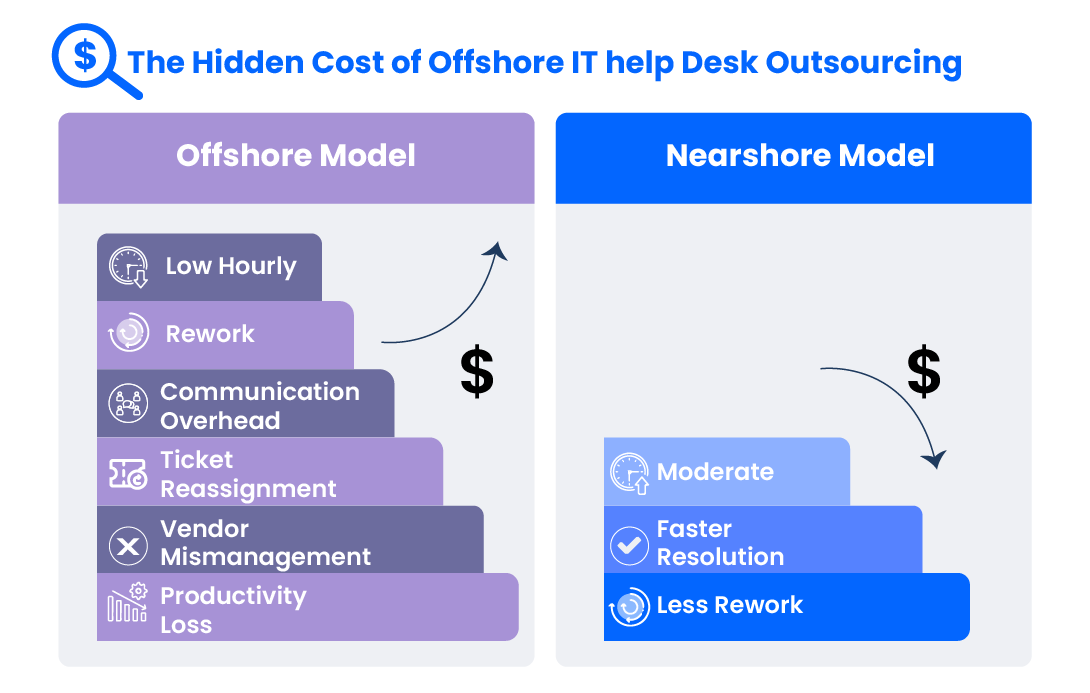
The hourly rate looks attractive. The total cost of engagement often tells a different story.
Research puts vendor mismanagement losses at 2% to 11% of total contract value. On a $500K annual help desk spend, that’s $10,000 to $55,000 leaking through overlapping contracts, rework from miscommunication, and billing inconsistencies nobody is tracking. McKinsey has noted that poorly managed offshore projects frequently exceed timelines due to communication misalignment. And when Gartner looked at enterprises that consolidated their tools and nearshored, those companies saw a 30% reduction in run-rate costs and reached revenue 25% faster. The savings didn’t come from cheaper rates. They came from cutting the waste that cheap rates generate.
Learn more about: Top it helpdesk services providers north america
Compliance gets harder at a distance
Black Book Research surveyed 264 payer executives and found that 77% expect third-party risk requirements to tighten materially in 2026, including mandatory subcontractor disclosure and audit rights. If your offshore vendor ecosystem can’t withstand that scrutiny, you have a problem that goes beyond inconvenience.
CIO.com reports the failure rate of outsourcing relationships sits between 40% and 70%. Each additional offshore vendor is another roll against those odds.
What nearshore actually gets right
Same time zone, same-day resolution
ScaleUpAlly’s 2025 nearshore outsourcing data tells the story pretty clearly: nearshore teams complete projects 40% faster than offshore alternatives, with 75% fewer communication problems. The success rate gap is just as telling: 80% for nearshore projects versus 60% for offshore. That 20-point spread comes down to one thing: people working in the same part of the day can actually talk to each other when something goes wrong.
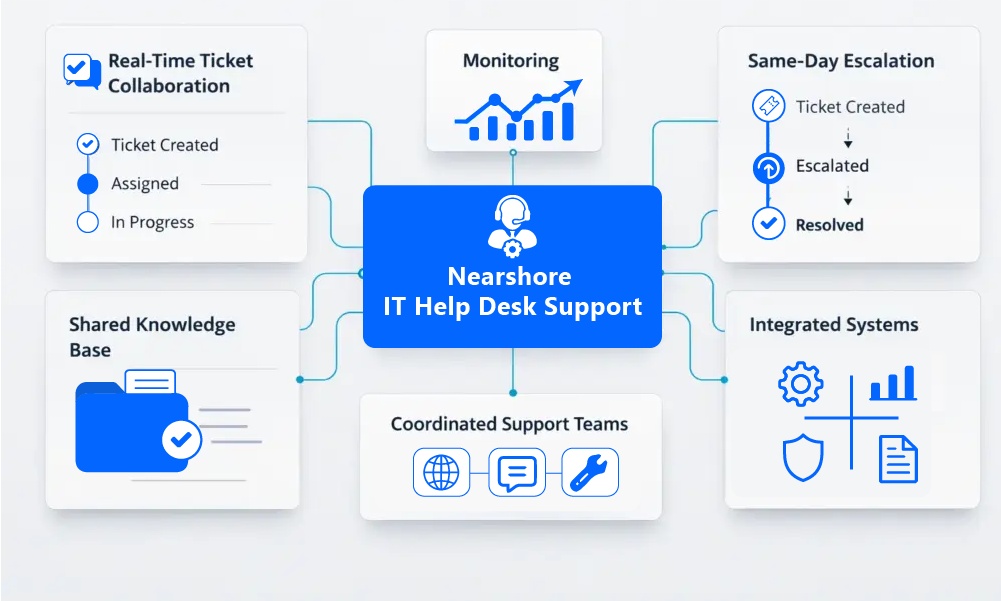
Within 1-3 time zones, escalations happen the same business day. Stand-ups are live. Your P1 ticket gets specialist eyes within hours, not the next morning. For help desk work, where resolution speed is the metric that matters most, this alone changes the math.
Cultural fit shows up in the tickets
The Everest Group surveyed over 300 US businesses and found that for customer-facing operations, 67% choose nearshore locations. The primary factor wasn’t cost. It was quality of collaboration.
For help desks, that translates into agents who understand escalation urgency, can engage in nuanced troubleshooting instead of reading from a decision tree, and match the communication style end users expect. It’s the difference between an agent who tells you “I will escalate this to the relevant team” and one who says “I can see the issue; let me pull in someone from the infrastructure team right now and we’ll stay on this together.” The second version requires cultural calibration that’s hard to train from 8,000 miles away.
The cost math, done right
Nearshore isn’t the cheapest option on paper. It was never supposed to be. According to Auxis’ 2026 help desk outsourcing trends data, companies save 30% to 50% on help desk labor costs through nearshoring versus in-house operations. HatchWorks puts nearshore rates at 46% lower than onshore on average. And Deloitte’s 2024 survey found that 88% of firms using managed or operated nearshore models report satisfaction, compared to 71% for traditional outsourcing approaches.
The insight worth sitting with: nearshore doesn’t win by being cheaper than offshore. It wins by eliminating the rework, the management overhead, and the productivity loss that makes offshore’s “cheap” rates expensive in practice.
Audits and compliance become realistic
Nearshore providers in the EU (Poland), MENA (Egypt), or Canada operate within regulatory frameworks that align with Western standards. ISO 27001, GDPR compliance, and SOC 2 are increasingly standard among serious nearshore providers. And there’s a practical piece that gets overlooked: when your provider is a short flight away, site visits, security audits, and in-person relationship management are logistically realistic. Try doing quarterly compliance audits with a vendor 14 time zones away.
The market numbers
The scale of this change is worth looking at in one place.
The nearshore outsourcing market hit $2.67 billion in 2025 and is projected to reach $3.99 billion by 2034 (Infosys BPM). Latin America grew 20% as a nearshore destination, with the broader LATAM outsourcing market approaching $20 billion (ScaleUpAlly and Alcor Research). Auxis reports that 90% of organizations considering new outsourcing destinations in 2026 are evaluating Latin America, and CBRE’s Scoring Tech Talent 2025 report ranked the region as the #1 up-and-coming tech talent market globally. BPO activity in LATAM is growing at 12% annually.
On the demand side, 50% to 65% of enterprises now outsource all or part of their IT help desk, more than double the adoption rate from a few years ago. Nearly 80% of those organizations rate the outsourced experience as “better” or the “same” as when they ran it in-house, according to data cited by Auxis and the HappySignals 2025 benchmark. Gartner estimates that by 2026, over 50% of mid-size US enterprises will have nearshore support centers in Latin America. And the Computer Economics report found that IT leaders now rank proximity as the number one factor when choosing an outsourcing provider, not cost.
One more from TSIA that’s worth flagging: providers using swarming and single-tier support models (which nearshore’s real-time collaboration makes possible) see Net Promoter Scores 12.4 points higher and contract renewal rates 5.4% higher than those who aren’t. That’s the retention advantage of a model built on speed rather than shift handoffs.
Where nearshore breaks down too
I want to be honest about something. Nearshore isn’t a magic fix. Geography alone solves nothing if the operational structure behind it is broken.
Nearshore with the wrong partner is just closer offshore. If the provider runs script-first L1 support with no real escalation depth, you’ve traded a 12-hour delay for a 2-hour delay on the same bad process. The ticket still bounces. The user is still frustrated. You’ve just shortened the waiting period.
Subcontracting is the other silent killer. Some nearshore providers handle daytime L1 work themselves, then subcontract overnight shifts or L2+ escalations to separate companies. The moment that happens, you’re back in a fragmented vendor setup with mismatched training, different quality standards, and split accountability. The CIO.com 40-70% failure rate? It applies to nearshore relationships too when the structure is wrong.
Pricing model matters as much as location. Deloitte’s 2024 data shows 67% of organizations now want outcome-based outsourcing. If a nearshore provider only offers cost-per-seat or hourly billing, their incentive is to fill seats, not resolve tickets. Those are two very different business models that happen to look the same on a proposal deck.
And then there’s AI. 83% of companies now expect outsourcing vendors to bring AI capabilities as part of service delivery (Deloitte 2024). But “we use AI” can mean anything. A chatbot on the front page is not the same as AI embedded across quality auditing, knowledge retrieval, and predictive ticket routing. That gap is enormous at scale, and most providers sit on the wrong side of it.
The real tell? Ask how long the average client stays. If a provider can’t give you a specific number, that’s your answer. High churn means you’ll be shopping again within 18 months.
What the change actually looks like
Companies that transition from offshore or in-house to a nearshore managed help desk tend to follow a similar arc. The first 30 days are knowledge transfer and tooling setup. By day 60, the nearshore team is operating at baseline. By day 90, they’re outperforming the previous setup on the metrics that matter.
That’s not theory. Here’s what the data looks like.
For a global logistics IT provider, the transition to a nearshore managed help desk team FlairsTech boosted ticket resolution to 92%, lifted agent utilization to 96%, and delivered six consecutive months of 100% customer satisfaction scores. Six months at 100%. That’s not a honeymoon period; it’s a structural result.
A global travel provider working with FlairsTech’s nearshore IT operations team hit 99% system uptime after struggling with fragmented offshore coverage that couldn’t maintain consistency across time zones.
What made the difference in both cases wasn’t one thing. It was the structure. Full L1-L5 pod ownership under one roof, no subcontracting. AI (AIMY) embedded across quality auditing and knowledge retrieval, with 98% retrieval accuracy and 3x more quality audits than before. Multilingual 24/7 coverage from a single organization across offices in Canada, Poland, and Egypt. 98% CSAT, 97% SLA success, and 95% quality scores across 100+ enterprise partners and 2,500+ delivered projects, with an average client tenure of over five years.
Book a free strategy session. No commitment. We’ll walk through your current setup, identify the gaps, and put together a help desk support plan with milestones and KPIs before you decide anything.
The bottom line
74% of companies are moving from offshore to nearshore. The success rate gap is 20 points. The cost savings hold up at 30-50% versus in-house, without the hidden overhead that erodes offshore’s rate advantage.
But here’s the part that doesn’t show up in benchmarks: the compounding advantage. Companies that set up nearshore partnerships now will have providers who deeply understand their systems, their users, and their escalation patterns by the time competitors are still running pilots. That institutional knowledge builds over months and years, and there’s no shortcut to it.
If you’re evaluating nearshore help desk services outsourcing right now, the question isn’t whether to make the move. It’s when, and with whom.
Schedule a free consultation and let’s figure it out.
Was this article helpful?

I use 8 years of content excellence experience to ensure everything you read is accurate, backed by real industry data and insights.